housing studies centre
on housing: articles
a case for spatial justice: affordable housing and 'reversed ghettos'
original publication: https://www.urbanlab.am/file_manager/Alt_urban_research_publication.pdf
“Before men began to act, a definite space had to be secured and a structure built where all subsequent actions could take place, the space being the public realm of the polis and its structure the law; legislator and architect belonged in the same category.”
(Arendt, 1958, pp. 194-195)
Thinking politically about space and justice
Hannah Arendt has written extensively on various modalities of space, defining both its physical and abstract manifestations. Her idea of civic engagement in the urban space (similar to the more ancient forms of participation in the life of the polis through active citizenship) has gradually transitioned from the domain of philosophical though into the realm of urban governance, with the intermediary help of social sciences. The relatively new research field of spatial justice, endeavours to bring findings from social justice into the executive policies of urban and regional planning. (Soja, 2009)
Borrowing the two well-studied notions from social sciences – distributive justice and procedural justice, – urban planning for justice promises to provide an insight into practical tools promoting a fair distribution of urban resources, underpinned by regulations ensuring participation and fair outcome. In theory, the governance arrangement for spatial justice envisioned so far, entails several assumptions: availability of sufficient resources for sensible distribution; adequate leverage over resource (re)distribution and procedures by local and national government; attractive incentives for the private sector; a potential for collaboration within different groups of the civil society; trust between the actors mentioned above as well as other stakeholders. In reality, a combination of these components is rarely realistic to come by in the so-called developed countries of the Global North, and are precisely the issues that developing economies are struggling to overcome.
“Jasper’s thought is spatial because it forever remains in reference to the world and the people in it, […] his deepest aim is to "create a space" in which the humanitas of man can appear pure and luminous. Thought of this sort, always "related closely to the thoughts of others," is bound to be political even when it deals with things that are not in the least political;…” (Arendt, 1968, p. 79)
In her laudatio to the psychiatrist-turned-philosopher Karl Jaspers, published in 1968, Arendt makes a case for spatial thinking being always a political thinking, which was not a given at that time. Only in the following decade would spatial thinking make its way back into social theory, replacing the established one-dimensional scale of comparison – based exclusively on time. Social constructs were studied in reference to history – with a specific model for the modern – thus, placing them at the corresponding point of development stage. A similar transformation has occurred in terming the states’ level of development, wherein the countries are grouped into two broad categories – Global South and Global North. Yet, despite the very specific spatial connotations conjured by the wording itself, the division is economic rather than geographic.
The problems of spatial planning in “backward” areas
“We are apt to take it for granted that economic and political associations will quickly arise wherever technical conditions and natural resources permit. If the state of the technical arts is such that large gains are possible by concerting the activity of many people, capital and organizing skill will appear from somewhere, and organizations will spring up and grow. This is the comfortable assumption that is often made.
The assumption is wrong because it overlooks the crucial importance of culture. People live and think in very different ways, and some of these ways are radically inconsistent with the requirements of formal organization. One could not, for example, create a powerful organization in a place where everyone could satisfy his aspirations by reaching out his hand to the nearest coconut. Nor could one create a powerful organization in a place where no one would accept orders or direction.” (Banfield, 1958, p. 8)
It was precisely the historic brand of comparing and contrasting that informed Banfield’s early work. In his highly influential sociological research based on observing the village life in Montegrano – in southern Italy of the mid-1950s – he refers to the local community as backward. Yet, he also offers an explanation as to why such communities do not summon the resources available to them, to solve some of the prosaic problems, by coining the term “amoral familism” – a kind of a society where each actor is only concerned with the short-term economic benefits for their own nuclear family, rather than acting for the collective good of the community as a whole. Through his research, Banfield demonstrates that in societies with defective culture (interchangeably replaced with social capital) at the level of the masses, a successful leadership is unlikely to emerge. This kind of analysis certainly does not deny the role distributive justice (or rather, the lack thereof) plays in aggravating the problems faced within separate communities. However, it also offers the following implications: firstly, it describes the civic society as an active participant in defining the urban processes, rather than merely a passive consumer of the decisions taken for them; secondly, emphasises the comparability of levels of (in)competence between the society and its government authorities.
For urban planners studying and implementing participatory design schemes in developing economies, it should come to mean that the action frameworks need to be clearly defined for each stakeholder, realistically assessing their possibilities and terms of involvement.
The even more wicked problems of planning in the “developed” urban areas
The Unheavenly City (Banfield, 1970) is the epitome of Banfield’s years of research and professional first-hand experience in disciplines associated with “urban affairs”, which he draws “on work in economics, sociology, political science, psychology, history, planning, and other fields”.
What Banfield demonstrated is that even in cities with forward societies, there are pockets of less developed areas, the “low-income areas” identified by him as the “lower-class”. The latter is remarkably identical to the Montegrano community with its “amoral familism” and impaired culture (read: social capital).
The critique of government programmes laid down in The Unheavenly City, has only been possible due to Banfield’s unique position as a multidisciplinary scholar closely familiar with the inner workings of executive departments, public programmes, and their expected versus real effects.
The uncertainty stemming from the complex dynamic processes taking place in cities is what creates the so-called wicked problems in urban planning – the problems that are defined by an ever-changing environment, with no precise
boundaries, and with multiple interconnected networks. Banfield (1974, p. 286) predicted that the technically trained persons working on urban problems – equipped with tools for data gathering and manipulation along with their analytical apparatus – could offer а more realistic view of the urban situation. Indeed, today cities are treated as complex systems with multiple, almost unsolvable problems tackled with tools from data science, wherein the so-called big data is then being run through algorithms to analyse and have a more integrated result.
A systematic approach in urban planning, based on large data-gathering, is a relatively new one in Armenia – mostly seen in the “smart city” initiatives launched by city authorities in Yerevan. Similar to other developing nations, the implementation of a centralized data collection and analysis system has been impeded by fragmented authorities – lack of coordinated actions resulting in inefficiencies and inflated transaction costs.
The perils of budget distribution
The essential theory of spatial equilibrium is purely descriptive: it reflects how opportunities and benefits are distributed throughout the urban space. However, the model in itself has no qualms about the distribution being unjust. Whereas spatial justice in cities is never an accident and is the result of politics and policies.
Overall, authorities of all tiers have their prioritised areas of budget spending – mostly defined by the voices of their constituency. A simple graph [Figure 1] from urban economics illustrates the link between government wealth distribution between the capital city and the rural areas, and likelihood of discontent and revolution.
For most governments, the administrative powers reside in the capital, which is why policymakers holding the power surround themselves with satisfied urbanites who have the benefits of quality housing and amenities, urban infrastructure, and good jobs. The extreme manifestations of such politics – with highly disproportionate distributions of government funding – happen in authoritative governments, giving rise to imperial cities. (Ades & Glaeser, 1995)Uneven investment into spatial development plagued the village of Montegrano in the 1950s, just as it does both urban and rural areas everywhere today; yet not all such instances should be a sign of malevolence.
1
In developing states investment capacity is limited, while most types of capital, along with majority of skilled labour, are concentrated in the capital cities. Urban and economic policies encouraging entrepreneurship of the capital-dwellers may create the stable environment necessary for steady in-flow of private capital, and lead to knowledge-based economy. One of two possible scenarios may play out. The positive one is where the benefits “trickle-down” from the emerged primate city to the less developed peripheral territories.
1 The theory of spatial equilibrium describes the link between location-related benefits (monetary and non-monetary) and the higher or lower costs offsetting the demand. In this way, better services, amenities, housing quality, business opportunities in a location in a city are associated with higher prices, and vice versa.

Figure 1.The impact of government funding distribution on probability of revolution. Adapted from Glaeser (2018)
Whereas the latter occurs when failing to timely decentralise the urban pull factors in favour of areas elsewhere in the country results in an inevitable rural-urban migration. In case of unprepared urban planning policies, the growing primate city will show big-city “symptoms”: urban sprawl, backlog of housing supply – leading to unaffordability, increasing rates of unemployment, and gentrification. Gentrification is additionally responsible for the shrinking social capital; policies benefitting developers at the expense of long-time city-dwellers and businesses, displace (and in some cases erase) some of the valuable pieces of the urban fabric representing the accumulation of the social capital.
Unequal distribution of resources and capital is apparent in Armenia, with the biggest share concentrating in Yerevan. Lax regulations, lack of control, and corruption in the construction sector have resulted in an overbuilt city centre accompanied by multiple cases of forced gentrification.The biggest impediment to long-term financial investment in the country (both domestic and external) is the overall market uncertainty arising from being a landlocked nation in a continuous state of conflict, the internal political instability, and corruption.
Housing boom, gentrification explosions, bursting bubbles
The post-WW2 decades marked a new era of global urbanisation – revolving around housing delivery. Each economic system, driving the growth in the cities, devised regulatory policies defining the supply mechanisms.
Suitable living environment NOT to every American family
In the US cities described by Banfield, the governmental attempts to create more equal conditions of housing, education and business opportunities, that began in the 50-60s, encouraged the rise of suburbs. While declaring their goal as “providing a suitable living environment to every American family” , the programmes turned out to benefit mainly the more well-off families and increased the rates of urban poverty. The initial round of policies, virtually, subsidised the middle class out of the central cities and older suburbs, which now were turned into poor neighbourhoods with dilapidating housing stock. Subsequently, with the appointment of a new head of the Housing and Home Finance Agency, the federal housing programmes, virtually, attempted to “attract the middle class back into the central city and to stabilize and restore the central business districts” (Banfield, 1974, p. 16). As a result, “hundreds of thousands of low-income people, … , were forced out of low-cost housing, …, in order to make way for luxury apartments, office buildings, hotels, civic centers, industrial parks, and the like”, (1974, p. 16) which led to the poor being left out in the highest-density slums. It was only later acknowledged that this process was a massive gentrification, which, in worst cases, prices the long-time residents and businesses out of their historic neighbourhoods and, thus, has a detrimental effect on the social capital of the area.
2
3
The success story of Europe: managing housing through associations A more demanding race for tackling the post-war housing shortage took place throughout the directly impacted European states. The organisation that “got it right” is the ever-evolving Dutch system of social housing associations, who acknowledged that mere provision is not enough, but consequential management and maintenance are necessary. (Hoekstra, 2013) Along with the physical upkeep of the housing stock, the associations monitor the social environment of the tenant communities. In line with the national policies on migration, they do provide subsidised housing to the migrants as well, which on one hand is a testimony to the society’s acceptance of pluralism, but more importantly, is a tool with which to leverage – control, if you will – the concentration of any one marginal group in a single compound. This approach – known as universal – prevents ghetto communities from emerging in urban areas and sends a clear message to every newcomer that certain rules and norms should be upheld.
The housing of the Soviet communism The perceptions around housing were drastically different in the Soviet states of the same period. In the spirit of Khrushchev’s promise voiced in 1961 – “to every family its own apartment” – the Soviet mass housing was designed to quickly and cheaply allocate dwellings to its vast population. In contrast to the Western housing models financed through mortgages and rent programmes, the publicly owned social housing of the USSR was granted by the virtue of citizenship along with other social benefits, even though not always fairly. Despite the unprecedented efficiency of the soviet prefabricated construction methods, the supply was still lagging behind the growing demand, never achieving a perfect distributive justice communism was designed to provide. Upon the collapse of the Soviet Union, its member states joined the market economy where the “housing question” is one of affordability.
5
Nowhere this failure has been as apparent as in the infamous Pruitt-Igoe public housing development. In a nation-wide attempt to stop racial segregation, the U.S. Department of Housing started ramping-up supply of subsidised housing and moving people en masse from run-down “bad” communities to brand new multi-apartment houses. This binary approach once again assumed “that economic and political associations will quickly arise wherever technical conditions and natural resources permit “, neglecting the complexity of other factors affecting the human behaviours and the choices they make.
2 The statement was part of the national goal stipulated in The Housing Act of 1949 (p. c. 308)
3 Interestingly, in the most official definition of gentrification in the US, the one we find in the report Health Effects of Gentrification by the Centers for Disease Control and Prevention (2015), there is a phrase:"Gentrification is a housing, economic, and health issue that affects a community's history and culture and reduces social capital”.
The preventive measures are carried out through coordinated actions by several agencies, depending on the nature of the issue for each specific case: health care institutions – in the case of mental or physical health concerns, police – where social misbehaviour is the problem, employment organisations – if rent arrears are caused by unemployment. Significant state interference in an economy as functional as the one achieved in the Netherlands, is an example of social market economy – indicating that regulated real estate markets can offer solutions to social inequality.
4
4 As a result of the 2008 global financial crisis, the demand for subsidized housing has increased, so did the cases of evictions – rare up to that point – overwhelmingly due to rent arrears.
The twenty-first century began with an accelerated increase in real estate prices, culminating in the 2008 financial crisis caused by the bursting bubbles of the housing markets. The following aftermath has created what is now known as housing affordability crisis, which has affected most globalized economies and constitutes one of the biggest contemporary urban challenges.
5 From the Report of the Central Committee of the CPSU to the 22nd Congress of the Communist Party of the Soviet Union (1961) delivered by N. S. Khrushchev
Clustering in space for agglomeration effects
In both developed and developing countries, cities are struggling to accommodate growing populations, all the while managing the negative externalities associated with growth. Yet, it is essential to remember that the solution does not lie in abstaining from growth. It is an empirical fact that high-density regions are also the ones enjoying the highest GDPs (the traditionally used indicator reflecting the nation’s economic prosperity and the change thereof). (Our World in Data, 2017) What most regions will struggle to summon, is a simultaneous combination of different types of capitals making controlled growth possible.
Economic growth is never synchronized throughout a territory, but rather tends to concentrate in select areas and is cumulative. In developing areas, where resources are scarce, the opportunities for substantial internal economies of scale are limited to very few large companies. Studies on regional economic development culminate in Michael Porter’s observation that small companies have the potential to generate both individual and local economic development by clustering geographically. (Porter, 1985)
Such co-creative initiatives allow each participant to benefit from division of labour within their common production process.
This phenomenon is also reflected in the theory of agglomeration economies, emerging as a benefit from people and/or their networks clustering in a relatively limited space within a city, defined by a specific type of activity. These effects are sometimes seen as a reason for the existence of cities, and are believed to create economies of scale; whereby, increase in productivity results from physical closeness of organisations to each other and resources, reflected in shrinking transportation costs, circulation and exchange of ideas and expertise creating a potential for innovative solutions. (Glaeser & Gottlieb, 2009) The most prominent example is the tech region Silicon Valley, whose growth – both in size and productivity – has generated an amalgam of externalities for San Francisco at large. Although government policies do have a role to play in such models, Porter believes that it is only marginal, and the efforts made by the companies to organise and maintain such clusters is the driving force. (Porter, 2009)
Make Reversed Ghettos, not gated communities
Both the backward village of Montegrano and the developed Unheavenly City featured groups falling into the “lower-class” category – with low concentration of social capital. The difference is their proportion relative to other categories – expressed in percentage. A community with a concentration of social capital gravitating towards 0% is a backward one — akin to the Montegrano of the 50s [Figure 2a]; whereas a developed society is one that features a denser overall concentration of social capital [Figure 2b,c].
Figure 2. Visualisation of development expressed in social capital concentration, where lighter colour signifies lower concentration: a) Backward Society with low concentration of social capital; b) Unheavenly City - an overall developed city with ghettos; c) Universal City – an overall developed city with policies reducing probability of segregated ghetto formation
The so-called “economic miracles” occur when substantial social and financial capitals come together in an environment of supportive political will, thus enabling multiple clusters to form and grow simultaneously. Incidentally, the capitals do not necessarily have to come from within the region. Such was the post-WW2 economic miracle of Germany [Figure 3a] – where the not yet dispersed local social capital was activated by the financial investments coming in through the Marshall Plan (Knowles, 2014); as well as the one taking place in the 21st century China [Figure 3b], where social backwardness was offset by monetising the natural resources to attract foreign social capital.
Figure 3. The economic miracles of 20th and 21st centuries: a) the post-WW2 Germany, where the local dense social capital was put into motion with external financial capital; b) the Chinese miracle, which is one based on abundant local natural resources (read: financial capital) attracting foreign social capital into multiple localities and specialization domains in the country
As for backward regions with scarce resources (including the financial capital) and low concentration of social capital: if a critical amount of people – equipped with knowledge and ability to self-organise – do cluster around an activity yielding higher returns than the current average for said city, the generated agglomeration effects may spill over to the surrounding areas, creating positive economic value for the city in general.
This model virtually represents a “Reversed Ghetto”: an urban area with a concentration of social capital significantly exceeding that of the average in the city. [Figure 4]

Figure 4. "Reversed Ghetto": an urban area with a concentration of social capital significantly exceeding that of the average of the city
It is essential that the “Reversed Ghettos” form precisely around labour and, spatially, remain permeable to the “outsiders”. When capital concentration happens around housing, in most cases, such situations give rise to gated communities (in some cases referred to as golden ghettos) which are designed to create socio-spatial segregation and are very unlikely to generate positive spread effects. Despite being a highly controversial practice (Peiser, 1998), such residential communities are still favoured in the developing world and keep spreading. In places where crime rates are high, the rationale behind building gated communities is the security – that the well-off minority is willing to pay for. Such arrangements emphasise and reinforce the procedural injustice, wherein public authorities are not presented with the demand to provide a due law and order for all citizens. Mostly, such neighbourhoods become a status identifier – a case particularly obvious in the fast-growing Chinese cities (Staub & Yu, 2014), where mass surveillance by itself acts as an equalizer of security conditions. In terms of urban fabric, gated communities frequently create impermeable superblocks reducing the walkability of the area. [Figure 5]
6
6 In their study, Staub and Yu (2014) also explore the hypothesis that the new “sealed residential quarters” are, in fact, consistent with the historically shaped Chinese social capital – reflected, first, in the traditional courtyard houses, and then, the socialist work-unit housing. All three forms revolve around community building and social control.
The agglomeration potential of the Armenian Engineering City
Currently, the community with most potential to generate large positive economic and societal effects in Armenia, is the IT industry: it has repeatedly demonstrated the ability to self-organize, attract funding, secure stable and above-average salaries. The latest long-term initiative based on a successful public-private partnership is the Engineering City project planned to be built at the outskirts of Yerevan, bringing together around two dozen of high-tech companies. Spatially, the City occupies 3 ha of a land plot flanked by medium traffic roads, with perimetrally positioned office buildings grouped around shared amenities, partially open to the public as well [Figure 6]. The project capitalises on social capital and expertise accumulated by the industry, domestic and foreign channels for investment, favourable policy environment. In return, it will produce new knowledge (through a new, jointly designed master’s programme), support emerging entrepreneurship (by housing a start-up incubator), create increased demand and supply of skilled labour.
7

Figure 5. Examples of gated communities in countries with different socioeconomic systems:
a) superblock of impermeable gated communities in Nankai district, in Tianjin (China)

b) the infamous The Retreat at Twin Lakes gated community in Sanford (Florida, US), which – after the shooting of a Black teenager mistaken for an intruder by a local resident – raised questions about both the ethics of such communities and security in multiracial neighbourhoods, gated or not
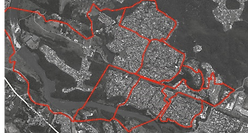
c) the Alphaville district in Sao Paulo (Brazil) that, over time, grew from a smaller gated community into a city within a city, gating nearly 20’000 affluent residents from the poorer densely populated surrounding region..
The Engineering City virtually represents a penetrable Reversed Ghetto made up of a cluster of organizations that are very likely to generate economies of scale through physical closeness to each other and availability of equipment.
In terms of resource distribution, the model is not fair. However, temporary public budget “maldistribution” and favourable policies supporting the Reversed Ghettos and the areas around it, may foster other hubs of knowledge to pop up and spread. Once the desired growth is obtained, it is the job of the policymakers to facilitate the development of yet uncultivated opportunities in other areas as well – to mitigate the possible backwash effects from the pull-push factors of the core-periphery dynamics.
7 The Engineering City: https://engineeringcity.am/ [Accessed 26 07 2021]

Figure 6. The Engineering City: a bird's eye view visualisation of the project.
References
Ades, A. F. & Glaeser, E. L., 1995. Trade and Circuses: Explaining Urban Giants. The Quarterly Journal of Economics, vol. 110, no. 1, pp. 195-227.
The Housing Act of 1949, c. 338, viewed 26 07 2021,
<https://govtrackus.s3.amazonaws.com/legislink/pdf/stat/63/STATUTE-63-Pg413.pdf>
Arendt, H., 1958. The Human Condition. s.l.:University of Chicago Press.
Arendt, H., 1968. Karl Jaspers: a laudatio. In: Men in dark times. New York: Harcourt, Brace & World, Inc., pp. 71-80.
Banfield, E. C., 1958. The Moral Basis of a Backward Society. Glencoe, Illinois: The Free Press.
Banfield, E. C., 1970. The Unheavenly City: The Nature and Future of Our Urban Crisis. Boston: Little, Brown and Company.
Banfield, E. C., 1974. The Unheavenly City Revisited. Boston: Little, Brown and Company.
Blakely, E. J. & Snyde, M. G., 1998. Separate places: Crime and security in gated communities.
Centers for Disease Control, 2015. Health Effects of Gentrification, viewed 26 07 2021, <https://www.cdc.gov/healthyplaces/healthtopics/gentrification.htm>
Report of the Central Committee of the CPSU to the 22nd Congress of the Communist Party of the Soviet Union, 1961, viewed 26 07 2021, <https://archive.org/details/DocumentsOfThe22ndCongressOfTheCpsuVolI/mode/2up>
Glaeser, E. L., 2018. “The Imperial City Model” [MOOC lecture]. In CitiesX: The Past, Present and Future of Urban Life [MOOC] HarvardX, viewed 26 07 2021, <https://courses.edx.org/courses/course-v1:HarvardX+Urban101x+1T2018/course/>
Glaeser, E. L. & Gottlieb, J. D., 2009. The Wealth of Cities: Agglomeration Economies and Spatial Equilibrium in the United States. Journal of Economic Literature, , 47(4), pp. 983-1028.
Hoekstra, J., 2013. Social housing in the Netherlands: the development of the Dutch social housing model. Barcelona, University of Barcelona, Institute of Environmental Science and Technology.
Knowles, C., 2014. Germany 1945–1949: a case study in post-conflict reconstruction, viewed 26 07 2021, <https://www.historyandpolicy.org/policy-papers/papers/germany-1945-1949-a-case-study-in-post-conflict-reconstruction>
Our World in Data, 2017. GDP per capita vs population density, 2017, viewed 26 07 2021, <https://ourworldindata.org/grapher/population-density-vs-prosperity>
Report of the Central Committee of the CPSU to the 22nd Congress of the Communist Party of the Soviet Union, viewed 26 07 2021, <https://archive.org/details/DocumentsOfThe22ndCongressOfTheCpsuVolI/mode/2up>
Peiser, R. B., 1998. Reducing crime through real estate development and management. Washington, D.C.: Urban Land Institute.
Porter, M. E., 1985. Competitive Advantage: Creating and Sustaining Superior Performance. New York: The Free Press.
Porter, M. E., 2009. Clusters and Economic Policy: Aligning Public Policy with the New Economics of Competition. Institute for Strategy and Competitiveness, October.
Soja, E. W., 2009. “The city and spatial justice” [« La ville et la justice spatiale », traduction : Sophie Didier, Frédéric Dufaux]. justice spatiale | spatial justice, September.
Staub, A. & Yu, Q., 2014. The “New” Gated Housing Communities in China: Implication for Urban Identity. Honolulu, HI, Architectural Research Centers Consortium (ARCC), pp. 545-553.